_edited.png)

Home › Our Services › Heritage & Period Restorations
Heritage & Period Home Restoration in Melbourne
Melbourne has more surviving Victorian and Edwardian housing stock than almost anywhere. It also has a lot of it that's been renovated badly - original detail stripped out in the seventies, extensions bolted on with no relationship to the house, and structural problems papered over rather than fixed.
Restoring a period home well is a different discipline from building new. The materials behave differently, the tolerances are different, the council has a view, and the house always has something to tell you that the drawings didn't.
What we restore

Victorian and Edwardian terraces
Single and double-fronted, including party wall work, verandah and cast-iron restoration, ceiling roses and cornice reinstatement, original fireplace and joinery conservation. Common across Seddon, Yarraville, Footscray and Kensington. Terrace bathrooms and kitchens are often restored at the same time.
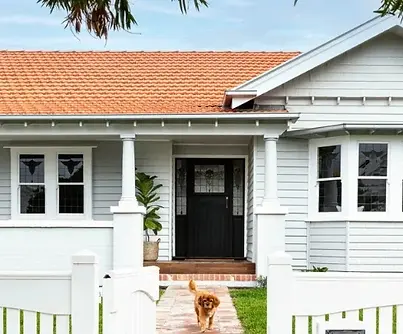
Californian bungalows
Interwar bungalows with their characteristic low pitched roofs, deep eaves and leadlight. Common work is opening the rear while preserving the street-facing form.

Weatherboard homes
Cladding repair and replacement, re-stumping, sash window restoration, and bringing services up to standard without gutting the interior.

Work within heritage overlay areas
Where council controls what can change, and what's visible from the street matters as much as what's structurally sound. Extensive across Yarraville, Seddon and Williamstown.
What period homes bring that new builds don't
We plan for these rather than discover them mid-build:

Original materials that can't be bought
Matching brick, tessellated tile, pressed metal and specific timber profiles takes sourcing time. Some things get remade to match rather than replaced.

Structural surprises behind the plaster
Failed stumps, rotten bearers, termite damage, previous alterations done without permits or engineering.

Hazardous materials
Lead paint and asbestos are routine in pre-1990 housing. Both need licensed removal, and both need to be in the budget from day one.
_jfif.jpg)
Council requirements
Heritage overlays constrain what's visible, what can be demolished, and sometimes what materials are permitted.
_jfif.jpg)
Services at the end of their life
Knob-and-tube wiring, galvanised pipe, no insulation. Most period restorations are also full services replacements.
This is why we build a genuine contingency into heritage quotes and say so, rather than quoting tight and recovering it through variations.
Restoration and modernisation together
Most clients want both - the front of the house honest to its period, the back of it a house you'd actually want to live in. That's the interesting part of the work, and it's where the design needs to be good. A rear extension on a Victorian terrace should read as clearly contemporary rather than as fake heritage; councils generally prefer it and so does the house.
We work with architects who specialise in this and can recommend practices whose heritage work we've built.
Timeframes and cost
Heritage and planning approvals
12–20 weeks
Restoration with rear extension
8–14 months
Facade and detail restoration only
2–4 months
Heritage projects take longer than the equivalent non-heritage work - roughly 20 to 30 percent longer, split between the approvals stage and the unforeseen work that period buildings produce.
We needed to remodel the kitchen and shift the laundry into a new location as we outgrew our current kitchen. Dean and the team were extremely professional throughout the whole process. The communication was on point and the result, fantastic. Throughout the whole process we felt informed through honest, clear communication. Can't wait to use Novastri again for future renovation projects.
Boushra N.
Melbourne, VIC
Brilliant, professional, amazing communication and timely - we could not have asked for more. Highly recommended. I have never seen such amazing tiling and we had difficult tiles to work with. Recommendations and ideas for the 3 bathrooms were brilliant and we are so happy with all the work Dean did for us. Thanks Dean. We have never had such a brilliant experience with renovations.
Lisa H.
Melbourne, VIC
Amazing work, Dean was professional and on point with his planning. I was kept updated with all progress & developments. No unexpected surprises as the quality was maintained throughout the project. I’ll be using Novastri again for future projects. My reconstructed balconies have added increased value to the property. Thank you Novastri.
Ivan
Melbourne, VIC
Common
Questions
What can I change in a heritage overlay?
Generally, what's visible from the street is tightly controlled and the rear is more flexible. Interiors are usually not controlled unless the property is individually listed. The overlay's specific statement of significance tells you what council is actually protecting, and that's the document to read first.
Do I need a heritage consultant?
For overlay properties requiring a permit, usually yes - a heritage impact statement is commonly required. We coordinate this.
Can I get modern energy performance in a period home?
To a point, and it's worth doing. Underfloor and ceiling insulation, draught sealing, and double glazing in heritage-appropriate sash profiles make a substantial difference. Wall insulation in solid brick is harder and needs care to avoid moisture problems.
How do you handle asbestos and lead paint?
Licensed removal, with clearance certificates, priced in the original quote rather than raised as a variation.
Will restoration cost more than a new build?
Per square metre, often yes. What you're buying is a house that can't be built again.
Are you licensed and insured?
Yes - registered building practitioner with full public liability and domestic building insurance. Our work carries a structural warranty.